Valentine’s Day is celebrated on February 14. It is a festival of romantic love and many people give cards, letters, flowers or presents to their spouse or partner. They may also arrange a romantic meal in a restaurant or night in a hotel. Common symbols of Valentine’s Day are hearts, red roses and Cupid.
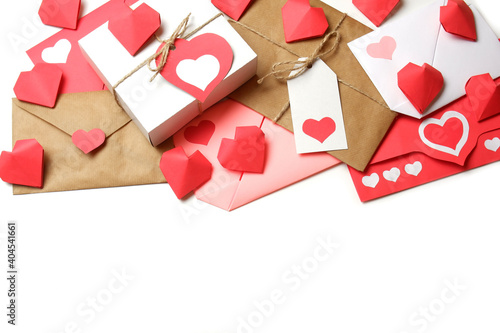
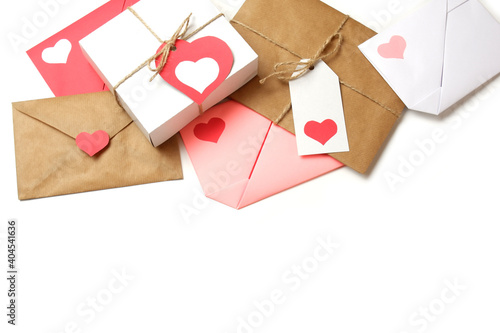
White gift box with red label in a heart form, gift wrapped in brown craft paper, tied with twine with a bow, envelope from craft paper with red heart on white background isolated
Origins to a Bloody Pagan Festival. Some trace Valentine’s Day origins to a Christian effort to replace a pagan fertility festival that has been dated as far back as the 6th century B.C. During the festival of Lupercalia, Roman priests would sacrifice goats and dogs and use their blood-soaked hides to slap women on the streets, as a fertility blessing. According to legend, women would later put their names in an urn and be selected to be paired with a man for a year.
White gift box with red label in a heart form, gift wrapped in brown craft paper, tied with twine with a bow, envelope from craft paper with red heart, 3D paper hearts on white background isolated
Origins of Valentine’s Day: A Pagan Festival in February While some believe that Valentine’s Day is celebrated in the middle of February to commemorate the anniversary of Valentine’s death or burial–which probably occurred around A.D. 270–others claim that the Christian church may have decided to place St. Valentine’s feast day in the middle of February in an effort to “Christianize” the pagan celebration of Lupercalia. Celebrated at the ides of February, or February 15, Lupercalia was a fertility festival dedicated to Faunus, the Roman god of agriculture, as well as to the Roman founders Romulus and Remus. To begin the festival, members of the Luperci, an order of Roman priests, would gather at a sacred cave where the infants Romulus and Remus, the founders of Rome, were believed to have been cared for by a she-wolf or lupa. The priests would sacrifice a goat, for fertility, and a dog, for purification. They would then strip the goat’s hide into strips, dip them into the sacrificial blood and take to the streets, gently slapping both women and crop fields with the goat hide. Far from being fearful, Roman women welcomed the touch of the hides because it was believed to make them more fertile in the coming year. Later in the day, according to legend, all the young women in the city would place their names in a big urn. The city’s bachelors would each choose a name and become paired for the year with his chosen woman. These matches often ended in marriage.
White gift box with red label in a heart form, gift wrapped in brown craft paper, tied with twine with a bow, envelope from craft paper with red heart on white background isolated
The day first became associated with romantic love within the circle of Geoffrey Chaucer in the 14th century, when the tradition of courtly love flourished. In 18th-century England, it grew into an occasion in which couples expressed their love for each other by presenting flowers, offering confectionery, and sending greeting cards (known as «valentines»). Valentine’s Day symbols that are used today include the heart-shaped outline, doves, and the figure of the winged Cupid. Since the 19th century, handwritten valentines have given way to mass-produced greeting cards. In Europe, Saint Valentine’s Keys are given to lovers «as a romantic symbol and an invitation to unlock the giver’s heart», as well as to children to ward off epilepsy (called Saint Valentine’s Malady).
Red, pink, white paper envelopes with colored hearts, 3D handmade paper hearts on white background. Love, Valentine’s, mother’s, women’s day, relations, wedding, romantic template copy space
What is Valentine’s Day in Contemporary Times? While Valentine’s Day is celebrated in most countries, different cultures have developed their own traditions for this festival. In some parts of the world Valentine’s Day is observed as a day for expressing love between family members and friends, rather than that of romantic couples. Some traditions include leaving lollies and gifts for children and others include acts of appreciation between friends. Valentine’s Day is most commonly associated with romantic love, with millions of Valentine’s Day cards being exchanged each year. Gifts of flowers or a single red rose are sent with romantic messages to loved ones and couples spend special time together. Many couples choose to celebrate Valentine’s Day with dinner, a picnic or special home-cooked meal. Many restaurants offer Valentine’s Day dinner promotions and food is often presented with symbols of love like hearts and flowers. Another popular Valentine’s Day activity is to indulge in a luxury hotel stay in a beautiful location, allowing a couple to get away from it all and enjoy some quality time together. Marriage proposals are also popular on Valentine’s Day, and it is often chosen as the perfect day to express their love and commitment. Some marriage proposals are delivered very creatively, such as after climbing to the top of a mountain, or posting a message on a billboard. Whatever the method, marriage proposals made on Valentine’s Day are generally romantic and memorable.
Red, pink, white paper envelopes with colored hearts on white background copy space. Love, Valentine’s, mother’s, women’s day, relations, wedding, romantic concept
What is Valentine’s Day? St Valentine’s Day is an annual festival to celebrate romantic love, friendship and admiration. Every year on 14 February people celebrate this day by sending messages of love and affection to partners, family and friends. Couples send Valentine’s Day cards and flowers and spend special time together to honour their love for each other.
Composition from several handmade 3D red paper hearts on white background isolated. Love, Valentine’s, mother’s, women’s day, relations, wedding, romantic template copy space
Box of Chocolates. The Valentine’s Day tradition of giving a box of candy was started in the 19th century by Richard Cadbury, a scion of a British chocolate manufacturing family. With a new technique recently established at the company to create more varieties of chocolate, Cadbury pounced on the opportunity to sell the chocolates as part of the beloved holiday.
Composition from several red paper hearts on white background isolated. Love, Valentine’s, mother’s, women’s day, relations, wedding, romantic offer, card, invitation, template copy space
How did Valentine’s Day develop? It wasn’t until more than 200 years later that 14 February was proclaimed St Valentine’s Day. By this time Rome had become Christian and the Catholic Church was determined to stamp out any remaining paganism. A pagan fertility ritual was held in February each year and the Pope abolished this festival and proclaimed 14 February Saint Valentine’s Day, thus establishing this feast day on the Catholic Calendar of Saints. The poet Chaucer in the Middle Ages was the first to link St Valentine with romantic love. This was the beginning of the tradition of courtly love, a ritual of expressing love and admiration, usually in secret. This custom spread throughout Europe and stories grew about a High Court of Love where female judges would rule on issues related to love on 14 February each year. Historians believe that these meetings were in fact gatherings where people read love poetry and played games of flirtation.
Red, pink, white paper envelopes with colored hearts, white gift box with red label in a heart form, envelope from craft paper with red heart, white gift box with red label in a heart form on white
Valentine’s Day is named after Saint Valentine, a Catholic priest who lived in Rome in the 3rd Century. There are many stories about St Valentine and over time these stories grew into the legend we know today.
Envelopes from red paper, craft paper with hearts, red, pink, white paper envelopes, white gift box with red label in a heart form, gift wrapped in brown craft paper, tied with twine with a bow
The day first became associated with romantic love within the circle of Geoffrey Chaucer in the 14th century, when the tradition of courtly love flourished. In 18th-century England, it grew into an occasion in which couples expressed their love for each other by presenting flowers, offering confectionery, and sending greeting cards (known as «valentines»). Valentine’s Day symbols that are used today include the heart-shaped outline, doves, and the figure of the winged Cupid. Since the 19th century, handwritten valentines have given way to mass-produced greeting cards. In Europe, Saint Valentine’s Keys are given to lovers «as a romantic symbol and an invitation to unlock the giver’s heart», as well as to children to ward off epilepsy (called Saint Valentine’s Malady).