‘Vinegar Valentines’ Discouraged Suitors. During the Victoria Era, those who didn’t want the attention of certain suitors would anonymously send “vinegar valentines.» According to Smithsonian, these cards, also called penny dreadfuls, were the antithesis of customary valentines, comically insulting and rejecting unwanted admirers. They were later used to target suffragettes in the late 19th and early 20th century.
Love, Valentine’s, women’s day, relations, romantic design with gifts and envelope, wrapped in brown craft paper, tied with twine with bows, labels, handmade paper roses and hearts on wooden boards
‘Vinegar Valentines’ Discouraged Suitors. During the Victoria Era, those who didn’t want the attention of certain suitors would anonymously send “vinegar valentines.» According to Smithsonian, these cards, also called penny dreadfuls, were the antithesis of customary valentines, comically insulting and rejecting unwanted admirers. They were later used to target suffragettes in the late 19th and early 20th century.
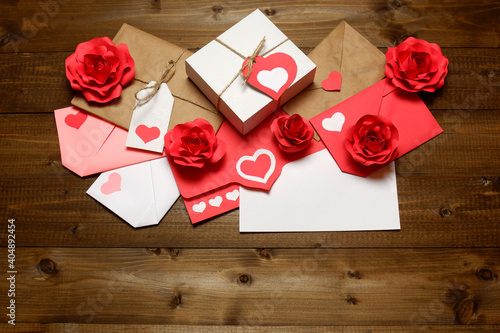
Gifts and envelopes, colored and wrapped in brown craft paper, tied with twine with bows and labels, hearts and roses on wooden planks background. Love, Valentine’s, women’s day, romantic concept
Eventually, Valentine was found out and jailed for his crimes against Claudius. While imprisoned, Valentine cared for his fellow prisoners and also his jailor’s blind daughter. Legend has it that Valentine cured the girl’s blindness and that his final act before being executed was to write her a love message signed ‘from your Valentine’. Valentine was executed on 14 February in the year 270.
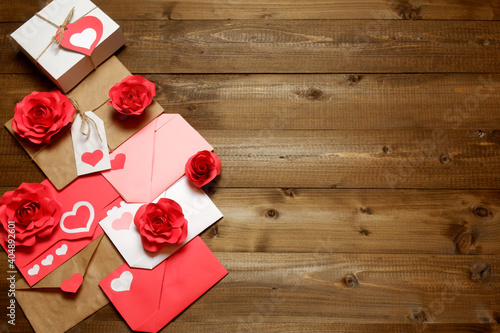
Gifts and envelopes, colored and wrapped in brown craft paper, tied with twine with bows and labels, hearts on wooden planks background. Love, Valentine’s, mother’s, women’s day, romantic template
Origins of Valentine’s Day: A Pagan Festival in February While some believe that Valentine’s Day is celebrated in the middle of February to commemorate the anniversary of Valentine’s death or burial–which probably occurred around A.D. 270–others claim that the Christian church may have decided to place St. Valentine’s feast day in the middle of February in an effort to “Christianize” the pagan celebration of Lupercalia. Celebrated at the ides of February, or February 15, Lupercalia was a fertility festival dedicated to Faunus, the Roman god of agriculture, as well as to the Roman founders Romulus and Remus. To begin the festival, members of the Luperci, an order of Roman priests, would gather at a sacred cave where the infants Romulus and Remus, the founders of Rome, were believed to have been cared for by a she-wolf or lupa. The priests would sacrifice a goat, for fertility, and a dog, for purification. They would then strip the goat’s hide into strips, dip them into the sacrificial blood and take to the streets, gently slapping both women and crop fields with the goat hide. Far from being fearful, Roman women welcomed the touch of the hides because it was believed to make them more fertile in the coming year. Later in the day, according to legend, all the young women in the city would place their names in a big urn. The city’s bachelors would each choose a name and become paired for the year with his chosen woman. These matches often ended in marriage.
Gifts and envelopes, colored and wrapped in brown craft paper, tied with twine with bows and labels, hearts on wooden planks background. Love, Valentine’s, mother’s, women’s day, romantic template
Valentine’s Day is celebrated on February 14. It is a festival of romantic love and many people give cards, letters, flowers or presents to their spouse or partner. They may also arrange a romantic meal in a restaurant or night in a hotel. Common symbols of Valentine’s Day are hearts, red roses and Cupid.
Love, Valentine’s, women’s day, relations, romantic design with gifts and envelope, wrapped in brown craft paper, tied with twine with bows, labels, handmade paper roses and hearts on wooden boards
Cupid Began as a Greek God. The chubby baby with wings and a bow and arrow that we call Cupid has been associated with Valentine’s Day for centuries. However, before he was renamed Cupid, he was known to the ancient Greeks as Eros, the god of love. Eros, the son of Greek goddess Aphrodite, would use two sets of arrows—one for love and another for hate—to play with the emotions of his targets. It wasn’t until stories of his mischief were told by Romans that he adopted the childlike appearance that we recognize today.
Love, Valentine’s, women’s day, relations, romantic design. Gifts, love letters, colored and wrapped in brown craft paper, tied with twine with bows, labels, 3D handmade paper roses on wooden planks
The day first became associated with romantic love within the circle of Geoffrey Chaucer in the 14th century, when the tradition of courtly love flourished. In 18th-century England, it grew into an occasion in which couples expressed their love for each other by presenting flowers, offering confectionery, and sending greeting cards (known as «valentines»). Valentine’s Day symbols that are used today include the heart-shaped outline, doves, and the figure of the winged Cupid. Since the 19th century, handwritten valentines have given way to mass-produced greeting cards. In Europe, Saint Valentine’s Keys are given to lovers «as a romantic symbol and an invitation to unlock the giver’s heart», as well as to children to ward off epilepsy (called Saint Valentine’s Malady).
Love, Valentine’s, women’s day, relations, romantic design with gifts and envelope, wrapped in brown craft paper, tied with twine with bows, labels, handmade paper roses and hearts on wooden boards
How did Valentine’s Day develop? It wasn’t until more than 200 years later that 14 February was proclaimed St Valentine’s Day. By this time Rome had become Christian and the Catholic Church was determined to stamp out any remaining paganism. A pagan fertility ritual was held in February each year and the Pope abolished this festival and proclaimed 14 February Saint Valentine’s Day, thus establishing this feast day on the Catholic Calendar of Saints. The poet Chaucer in the Middle Ages was the first to link St Valentine with romantic love. This was the beginning of the tradition of courtly love, a ritual of expressing love and admiration, usually in secret. This custom spread throughout Europe and stories grew about a High Court of Love where female judges would rule on issues related to love on 14 February each year. Historians believe that these meetings were in fact gatherings where people read love poetry and played games of flirtation.
Love, Valentine’s, women’s day, relations, romantic template with gifts and envelope, wrapped in brown craft paper, tied with twine with bows, labels, 3D handmade paper roses on wooden boards
Valentine’s Day is celebrated on February 14. It is a festival of romantic love and many people give cards, letters, flowers or presents to their spouse or partner. They may also arrange a romantic meal in a restaurant or night in a hotel. Common symbols of Valentine’s Day are hearts, red roses and Cupid.
Few handmade red paper roses on brown wooden planks background. Love, Valentine’s, mother’s, women’s day, relations, romantic, wedding template
Origins of Valentine’s Day: A Pagan Festival in February While some believe that Valentine’s Day is celebrated in the middle of February to commemorate the anniversary of Valentine’s death or burial–which probably occurred around A.D. 270–others claim that the Christian church may have decided to place St. Valentine’s feast day in the middle of February in an effort to “Christianize” the pagan celebration of Lupercalia. Celebrated at the ides of February, or February 15, Lupercalia was a fertility festival dedicated to Faunus, the Roman god of agriculture, as well as to the Roman founders Romulus and Remus. To begin the festival, members of the Luperci, an order of Roman priests, would gather at a sacred cave where the infants Romulus and Remus, the founders of Rome, were believed to have been cared for by a she-wolf or lupa. The priests would sacrifice a goat, for fertility, and a dog, for purification. They would then strip the goat’s hide into strips, dip them into the sacrificial blood and take to the streets, gently slapping both women and crop fields with the goat hide. Far from being fearful, Roman women welcomed the touch of the hides because it was believed to make them more fertile in the coming year. Later in the day, according to legend, all the young women in the city would place their names in a big urn. The city’s bachelors would each choose a name and become paired for the year with his chosen woman. These matches often ended in marriage.